📋 Table of Contents
- 1. Executive Overview: Finance Act 2025–2026 Tax Landscape
- 2. Visual Infographic: The 6 Progressive Salary Tax Slabs
- 3. Comprehensive Analysis of Each FBR Salary Tax Slab (Slabs 1 to 6)
- 4. Complete Salary-by-Salary Tax Comparison Table (Rs. 50K to 1M)
- 5. High Earner Surcharge & Super Tax Regulations
- 6. Salaried vs. Non-Salaried Individual Rates: Crucial Distinctions
- 7. 3-Year Historical Evolution of Pakistan Salary Tax Rates
- 8. Practical Take-Home Pay Optimization Strategies
- 9. Frequently Asked Questions (FAQs)
The Federal Board of Revenue (FBR) operates a progressive income tax regime under the First Schedule, Part I, Division I of the Income Tax Ordinance 2001. Under the statutory mandates of the Finance Act 2025–2026, progressive tax rates for salaried individuals range from 0% up to 35%, alongside targeted surcharges for high-net-worth earners. This guide provides an exhaustive, authoritative breakdown of each tax bracket, effective tax rates, take-home salary implications, and payroll compliance requirements.
1. Executive Overview: Finance Act 2025–2026 Tax Landscape
Pakistan's personal income tax system is structured to ensure horizontal and vertical equity: individuals with lower income pay little or no tax, while higher-income professionals contribute a proportionally higher share of their earnings. For salaried individuals (where salary constitutes more than 75% of total annual income), the progressive schedule is organized into six distinct statutory slabs.
2. Visual Infographic: The 6 Progressive Salary Tax Slabs
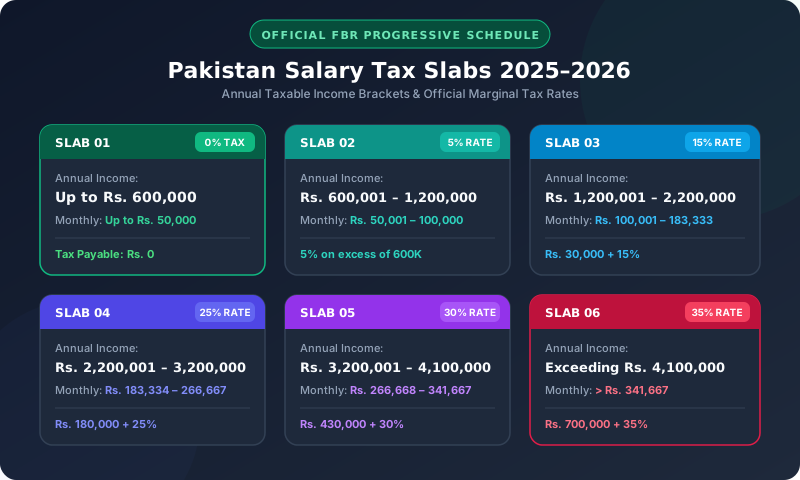
The infographic below illustrates the 6 statutory salary tax brackets, their respective monthly and annual thresholds, and the official marginal tax rates:
3. Comprehensive Analysis of Each FBR Salary Tax Slab (Slabs 1 to 6)
Each of the six brackets features unique characteristics and mathematical parameters. Here is the in-depth breakdown of how each bracket operates:
Slab 1: Annual Income Up to PKR 600,000 (Tax-Free Zone)
- Monthly Salary Range: Up to PKR 50,000
- Statutory Tax Rate: 0.00%
- Fixed Base Tax: PKR 0
- Take-Home Impact: 100% of gross earnings are retained by the employee. Employers are prohibited from deducting withholding tax under Section 149 for employees in this bracket.
Slab 2: Annual Income from PKR 600,001 to PKR 1,200,000 (Entry Tax Bracket)
- Monthly Salary Range: PKR 50,001 to PKR 100,000
- Statutory Tax Rate: 5% of the amount exceeding PKR 600,000
- Fixed Base Tax: PKR 0
- Maximum Annual Tax in this Slab: PKR 30,000 (at PKR 100,000 monthly)
- Maximum Monthly Tax in this Slab: PKR 2,500
- Effective Tax Rate: Ranges from 0.01% at PKR 51,000 up to 2.50% at PKR 100,000.
Slab 3: Annual Income from PKR 1,200,001 to PKR 2,200,000 (Mid-Management Bracket)
- Monthly Salary Range: PKR 100,001 to PKR 183,333
- Statutory Tax Rate: PKR 30,000 + 15% of the amount exceeding PKR 1,200,000
- Fixed Base Tax: PKR 30,000 (the cumulative tax from Slab 2)
- Maximum Annual Tax in this Slab: PKR 180,000
- Maximum Monthly Tax in this Slab: PKR 15,000
- Effective Tax Rate: Progresses from 2.5% to 8.18%.
Slab 4: Annual Income from PKR 2,200,001 to PKR 3,200,000 (Senior Professional Bracket)
- Monthly Salary Range: PKR 183,334 to PKR 266,667
- Statutory Tax Rate: PKR 180,000 + 25% of the amount exceeding PKR 2,200,000
- Fixed Base Tax: PKR 180,000
- Maximum Annual Tax in this Slab: PKR 430,000
- Maximum Monthly Tax in this Slab: PKR 35,833
- Effective Tax Rate: Progresses from 8.18% up to 13.44%.
Slab 5: Annual Income from PKR 3,200,001 to PKR 4,100,000 (Executive Leadership Bracket)
- Monthly Salary Range: PKR 266,668 to PKR 341,667
- Statutory Tax Rate: PKR 430,000 + 30% of the amount exceeding PKR 3,200,000
- Fixed Base Tax: PKR 430,000
- Maximum Annual Tax in this Slab: PKR 700,000
- Maximum Monthly Tax in this Slab: PKR 58,333
- Effective Tax Rate: Progresses from 13.44% up to 17.07%.
Slab 6: Annual Income Exceeding PKR 4,100,000 (Top Executive Bracket)
- Monthly Salary Range: Exceeding PKR 341,667
- Statutory Tax Rate: PKR 700,000 + 35% of the amount exceeding PKR 4,100,000
- Fixed Base Tax: PKR 700,000
- Marginal Rate: Every additional 100 rupees earned above PKR 4.1M incurs 35 rupees in income tax.
- Effective Tax Rate: Starts at 17.07% and gradually approaches 30%+ on high executive packages.
4. Complete Salary-by-Salary Tax Comparison Table (Rs. 50K to 1M)
Below is the complete official calculation schedule across standard salary milestones. On mobile devices, this data is displayed as native responsive milestone cards to guarantee a 100% fit-to-screen experience without awkward horizontal scrolling:
| Monthly Salary | Annual Income | Monthly Tax | Annual Tax | Effective Rate |
|---|---|---|---|---|
| Rs. 50,000 | Rs. 600,000 | Rs. 0 | Rs. 0 | 0.00% |
| Rs. 75,000 | Rs. 900,000 | Rs. 1,250 | Rs. 15,000 | 1.67% |
| Rs. 100,000 | Rs. 1,200,000 | Rs. 2,500 | Rs. 30,000 | 2.50% |
| Rs. 125,000 | Rs. 1,500,000 | Rs. 6,250 | Rs. 75,000 | 5.00% |
| Rs. 150,000 | Rs. 1,800,000 | Rs. 10,000 | Rs. 120,000 | 6.67% |
| Rs. 200,000 | Rs. 2,400,000 | Rs. 19,167 | Rs. 230,000 | 9.58% |
| Rs. 250,000 | Rs. 3,000,000 | Rs. 31,667 | Rs. 380,000 | 12.67% |
| Rs. 300,000 | Rs. 3,600,000 | Rs. 45,833 | Rs. 550,000 | 15.28% |
| Rs. 400,000 | Rs. 4,800,000 | Rs. 78,750 | Rs. 945,000 | 19.69% |
| Rs. 500,000 | Rs. 6,000,000 | Rs. 113,750 | Rs. 1,365,000 | 22.75% |
| Rs. 750,000 | Rs. 9,000,000 | Rs. 201,250 | Rs. 2,415,000 | 26.83% |
| Rs. 1,000,000 | Rs. 12,000,000 | Rs. 288,750 | Rs. 3,465,000 | 28.88% |
5. High Earner Surcharge & Super Tax Regulations
Under recent legislative revisions, high-income salaried professionals earning in excess of PKR 10 Million annually (approximately PKR 833,333+ monthly) are subject to an additional 10% income surcharge on their computed income tax liability.
For example, if an executive's annual computed tax is PKR 3,000,000 and total income exceeds PKR 10M, the 10% surcharge adds an extra PKR 300,000 to the total payable tax, bringing the final liability to PKR 3,300,000.
6. Salaried vs. Non-Salaried Individual Rates: Crucial Distinctions
Many consultants and business owners ask why salaried individuals pay different tax rates than sole proprietorships or Association of Persons (AOPs):
Key Differences between Salaried and Non-Salaried Taxpayers:
- Tax-Free Threshold: Both salaried and non-salaried individuals enjoy a tax-free threshold of PKR 600,000 per year.
- Entry Tax Rate: Salaried employees pay 5% on the first tranche above 600K, whereas non-salaried individuals pay 15% on income between 600K and 1.2M.
- Deduction of Business Expenses: Business individuals can deduct rent, utility bills, employee wages, and depreciation from gross revenues. Salaried individuals cannot claim general lifestyle or commuting expense deductions against their salary.
7. 3-Year Historical Evolution of Pakistan Salary Tax Rates
To appreciate current tax rates, consider the historical context over the past three federal budgets:
- Finance Act 2022–2023: The highest tax bracket peaked at 32.5%, with a lower tax burden on the middle class.
- Finance Act 2023–2024: Progressive marginal rates were restructured upward to meet international fiscal targets, peaking at 35%.
- Finance Act 2024–2025 / 2025–2026: Maintained the 0% to 35% framework while introducing targeted surcharges on high-income professionals and standardizing withholding tax rules across electronic payroll systems.
8. Practical Take-Home Pay Optimization Strategies
To legally protect your hard-earned take-home salary, adopt these three proven methods:
- Request Medical Reimbursement Restructuring: Request your employer's HR department to structure medical allowances under actual expense reimbursement against NTN-verified doctor and pharmacy receipts. Under Clause 139, documented reimbursements are completely tax-free.
- Contribute to Voluntary Pension Funds (VPS): Allocate surplus savings into an SECP-regulated pension scheme under Section 63 to gain up to 20% tax rebates.
- Declare Advance Withholding Taxes in Annual FBR Return: Maintain receipts of all utility bills, mobile phone cards, vehicle token payments, and property transactions. These advance taxes directly offset your payable tax liability when filing on Iris.